Disclaimer: This post contains no sponsored products. In the future, I may use affiliate links, but currently, all links only lead to free information on my site.
Welcome to the second article in my “Chinese Tea for Beginners” series! (If you missed the first one, you can read A Beginner’s Guide to Chinese Tea here).
I live in an environment surrounded by loose‑leaf tea. But honestly, as an experienced tea drinker, I did not care for tea at first. I began drinking it years ago purely for work. Before that, I preferred sodas like Coke and Sprite.
After making tea a daily habit, I lived through the “Golden Age” of China’s economy. During that time, I witnessed the craziest and busiest boom of the Chinese tea industry. Over those years, I attended countless high-end tea tastings and visited many local tea farms and shops. I became a regular at tea houses and have recommended everyday budget teas and luxury gift teas to many friends. Through all of this, I experienced the real benefits and joy of drinking tea, but I also learned the hidden rules of how the market works.
My goal today is simple: to be objective and neutral. I want to help you learn how to buy Chinese tea without making common mistakes, so you can find the best Chinese tea for beginners. We do not need to guess or buy blindly.
Here is my 5-point checklist to help you choose high quality Chinese tea like a local insider—especially if you are buying tea from China directly or asking someone to purchase it for you.
My 5-Point Checklist
| What to Check | Why It Matters |
|---|---|
| 1. Safety & Lab Testing | The strongest proof that the tea is safe to drink. |
| 2. Craft Consistency | Shows if the producer can control the quality every time. |
| 3. Harvest Season | Heavily affects the taste (especially for Green and Black tea). |
| 4. Tea Cultivar | Helps you understand the roots and quality of the tea plant. |
| 5. Growing Altitude | High-mountain environments create natural sweetness. |
1. Safety & Lab Testing: Is Chinese Tea Safe From Pesticides?

In China’s present food‑safety environment, this kind of tea is becoming more popular.
I am a bit unusual compared to other Chinese tea drinkers because I care deeply about safety tests. Many overseas buyers ask me: “Is Chinese tea safe from pesticides?” This is a very smart question. But every time I buy tea in China and ask the seller: “Do you have a lab test report?”
Guess what? Sellers look at me like I am an alien! In China, very few everyday buyers ask this. Most people only care about “famous mountains” or “famous masters.”
My Advice: When looking for safe organic tea, ask if the seller can provide official quality certifications. It is even better if they have third-party test reports (like SGS testing or Eurofins) that meet EU standards. If you are buying directly inside China, look for the official “Green Food” (绿色食品) certification.
2. Craft Consistency (Stability)
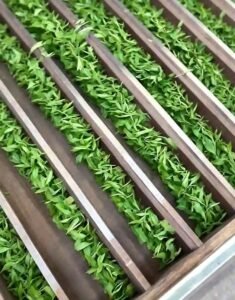
This is the first step to make whole-leaf Chinese tea.
In this step, tea leaves lose water and become softer.
It comes before the high‑heat tea‑fixing process.
If we put safety aside, this is the most important point when learning how to choose high quality Chinese tea.
Think of tea processing like cooking a meal. Imagine a top restaurant chef. His skills are excellent. But if he had a fight with his wife last night, or if he has a bad cold today, his food might not taste as good as usual. The quality changes based on his condition.
This is a real issue in the tea world. Recently, official industry‑issued “Tea Master” titles in China have been discontinued. Why? Traditional loose‑leaf tea relies heavily on human skill, unlike mass‑produced tea bags from large brands. The move is meant to shift focus back to consistent craftsmanship and skill inheritance, rather than relying on official titles as a marketing label.
This also shows that consistent craftsmanship in loose‑leaf tea is what people truly care about.
I know this from my own experience. I have bought my green tea from the same farmer for nearly 10 years. Their green tea is always excellent and stable. But this year, I tried their black tea and found the quality changed. It was not as rich as last year, and it lost its flavor after fewer brews. Making tea is complex—it involves the weather, the leaves, and the processing steps.
My Advice: Good tea sellers have stable quality year after year. Look for sellers with good reviews, and try their “sample packs” before buying a large amount.
3. Harvest Season: What is Spring Harvest Tea?
If you are wondering what is spring harvest tea and why everyone wants it, here is the secret: for green tea and black tea, Spring is the golden season. Spring leaves grow slowly in cool weather, so they taste richer, smoother, and sweeter.
Note: This rule is mostly for green and black tea. For oolong tea, puerh tea, or white tea, the harvest season rules are different.
4. Tea Cultivar: Look for Native Varieties (Qun Ti Zhong)
Great tea often comes from native, traditional tea bushes rather than newly bred plants. I wrote a detailed post about tea cultivar choices here . When buying, a knowledgeable seller should be able to tell you exactly what plant variety the tea comes from.
5. Growing Altitude: High-Mountain Chinese Tea Benefits
One of the biggest high mountain Chinese tea benefits is that the leaves usually taste smoother and less bitter due to the unique terroir (growing environment). To verify this, check if the tea has a Geographical Indication (GI) certification on the package. Do not just trust the seller’s words; look for the official stamp.
Note: Points 4 and 5 are extra bonus points. They are perfect if you want to become a serious tea lover, but do not worry too much about them if you just need a simple chinese tea beginners guide.
Conclusion
Finding a great tea is like making a new friend. It takes time to see if your personalities match. But once you find a good one, you can enjoy the friendship for a long time.
Have you ever tried Chinese tea with EU safety reports? Or have you tasted high-mountain spring tea? Share your stories in the comments below!