Disclaimer: This post contains no sponsored products. In the future, I may use affiliate links, but currently, any product links (like Amazon) are purely for your reference and I do not earn any commission from them.
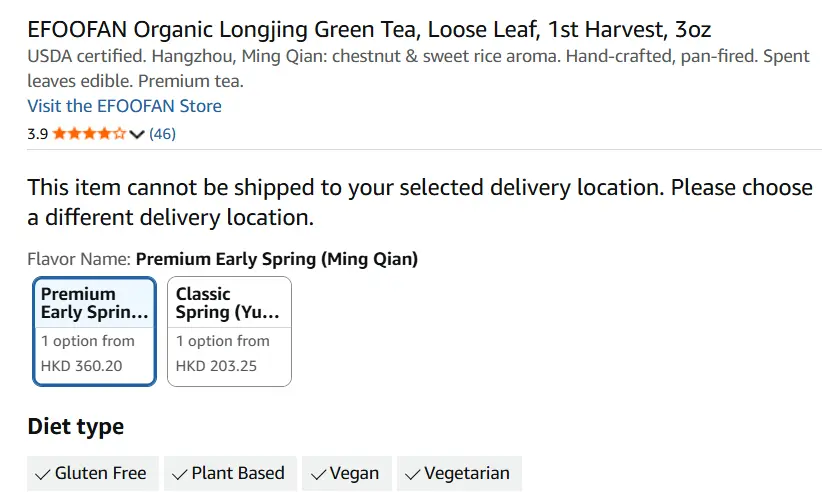
Screenshot from Amazon: EFOOFAN Longjing product page
If you search for Longjing (Dragon Well) green tea on Amazon or independent sites, you might feel shocked by the price. For example, a 3oz (85g) tin of EFOOFAN Organic Longjing Green Tea (Premium Early Spring) costs around $45.
Product Snapshot: EFOOFAN Organic Longjing
Before we analyze the price, let’s look at the basic specifications of this product found on Amazon:
- Full Name: EFOOFAN Organic Longjing Green Tea (Loose Leaf, 1st Harvest, 3oz)
- Origin: Hangzhou, China (Tianmu Mountains)
- Flavor Profile: Premium Early Spring (Ming Qian) with chestnut & sweet rice aroma
- Certifications: USDA Certified Organic & COR Certified Organic
- Price Reference: Around $45 USD for 3 oz (85g)
Many overseas buyers leave comments saying, “This is too expensive!”
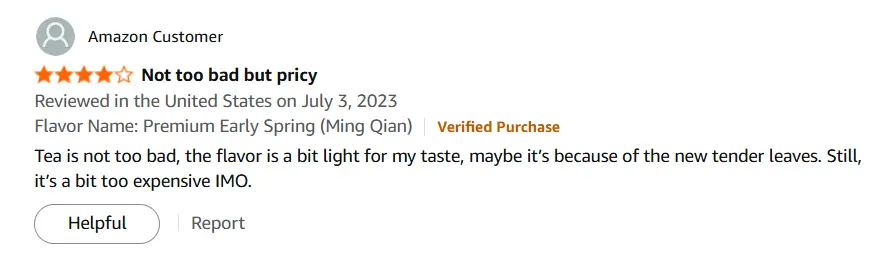
Screenshot from Amazon: EFOOFAN Longjing product page
Understanding the Chinese Tea Price Spectrum
In China, loose leaf tea is not just a grocery item; it is priced more like fine wine. Here is a rough guide to the price tiers of Chinese tea per pound (lb) on the real market, so you can see where this product fits:
| Price Tier (Per Pound) | What You Get | Who It Is For |
|---|---|---|
| $10 – $30 | Mass-produced, machine-harvested summer teas. Often heavy in bitterness. | Best for ice teas, mixing, or milk teas. |
| $30 – $80 | Late spring teas from standard tea gardens. Decent flavor, but low safety testing. | Everyday budget drinking (Everyday Tea). |
| $80 – $300 | Early Spring Single-Origin / Certified Organic Teas. Hand-picked, rich sweetness, strict safety reports. | Serious beginners and daily tea lovers (Entry Premium). |
| $300 – $1,000+ | Famous mountains, ancient tea trees, and the skilled craft of seasoned tea makers — all extremely rare. | Luxury gifts, business banquets, and hardcore collectors. |
| Priceless / Unavailable | Historical West Lake Core Zone Longjing. | A luxury status symbol. Even rich Chinese people can nearly never buy it on the open market. |
As you can see, at around $45 for 3oz (which calculates to roughly $240 per pound), the EFOOFAN tea sits right in the Entry Premium Tier. It is not a cheap grocery item, but it is far from a crazy luxury price.
As a Chinese tea insider, I completely understand why it looks pricey. Most people are used to tea bags. But today, I want to share the honest truth about how to buy Chinese tea and why a high price tag is sometimes completely normal—and even a good sign.
I haven’t purchased this exact tin of tea yet. Today, I want to do a quick “first impression” and price analysis. Based on my years of tea experience, I will help you look at their public labels to see if this tea is actually worth your $45.
Let’s break down this tea using my 5-point checklist to see if it is worth your money.
1. The Marketing Terms: “Ming Qian” vs. “Yu Qian”
The seller uses Chinese words like “Ming Qian” and “Yu Qian” to describe the flavors. For a complete beginner, this sounds like a secret code. Let me translate this into simple, international terms:
- Premium Early Spring (Ming Qian): This means the loose leaf tea was picked in late March. It is the absolute highest premium grade. Because the weather is still cool, the leaves grow very slowly. They have the highest natural sweetness and zero bitterness.
- Classic Spring (Yu Qian): This is the mid-April harvest. As the weather gets warmer, the leaves grow faster, so the price drops by almost half. It has a stronger, toastier flavor and is a great budget choice for everyday drinking.
So, if you buy the Early Spring version, you are paying for the rarest and best tasting window of the year.
2. The Location Secret: Tianmu Mountain vs. The “Core Zone”
The description says this tea is grown in the Tianmu Mountains of Hangzhou.
Let me tell you a secret that most sellers will never tell you: Tianmu Mountain is not the historical “core zone” for traditional West Lake Longjing.
But here is why that is actually a good thing for you:
- The Core Zone is a Luxury Myth: Authentic Longjing from the tiny, historical core villages in West Lake is an absolute luxury status symbol in China. It is used for high-end government gifts. Even rich Chinese people can nearly never buy it because the demand is too high and the supply is too small. It is practically unavailable on the open market.
- The Tianmu Mountain Advantage: Tianmu Mountain is in the western countryside of Hangzhou. While it is not the “core village,” it has a huge international title: it is a UNESCO World Biosphere Reserve. This means the tea grows in a fully protected, zero-pollution ancient forest.
3. High Safety Standards: USDA Organic Certification
This brings us to the most important question: Is Chinese tea safe from pesticides?
If a tea farm is inside a famous, crowded historical village, it is very hard to stay fully organic because neighboring farms might use chemicals. But because EFOOFAN’s tea is grown in the wild, protected forests of Tianmu Mountain, it can easily meet strict international safety rules.
This product has Certified USDA & COR Organic labels. To get these, the tea must pass strict third-party SGS testing for hundreds of pesticides. Getting and keeping these international certificates is incredibly expensive for a tea farm. When you pay $45, you are paying a “safety tax” for tested, clean tea.
4. Craftsmanship: Hand-crafted and Pan-fired
Finally, you are paying for intense human labor. Cheap tea is cut and harvested by giant machines. Authentic Longjing tea must be picked by hand, leaf by leaf.
Then, a seasoned tea expert stands in front of a hot metal wok, using their bare hands to press, flatten, and dry the leaves. This ancient technique creates the famous chestnut & sweet rice aroma. You are buying a piece of edible art, not just dried leaves.
Is it Worth It?
If you just want a cheap caffeine fix, this tea is not for you. Buy a soda or a box of industrial tea bags instead.
But if you want to experience high quality Chinese tea that is guaranteed safe, genuinely authentic, and picked during the golden window of spring, this price is completely fair. You are getting a clean, high-mountain tea from a UNESCO protected forest. In the world of premium tea, you truly get what you pay for.
Have you ever tried high-mountain spring tea? Does safety certification matter to you when buying tea? Let me know in the comments below!
Want to check out this tea yourself?
You can find the EFOOFAN Organic Longjing Green Tea here on Amazon. Note: This is a direct, non-affiliate link. I do not earn any money if you click or buy. I am sharing it purely because it is a perfect example of what safe, high-mountain Chinese tea looks like.