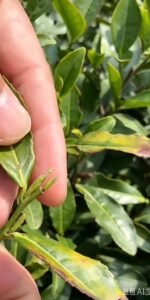
Image:Buds and tender leaves from the traditional Xinyang Maojian landrace cultivar
If you search for premium Chinese green tea like Xinyang Maojian on social media today, you will see something visually flawless. The dry leaves look like perfect, straight green needles, glittering with beautiful white hairs. In a glass cup, they stand up elegantly like miniature spears.
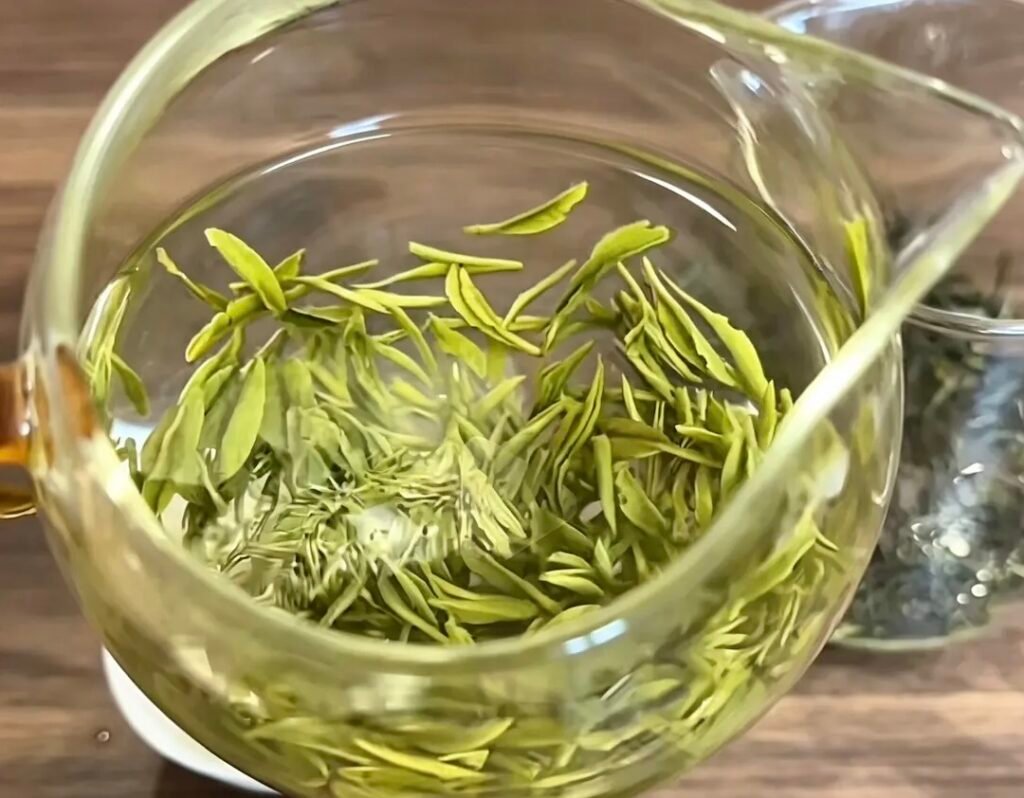
Image:This is Xinyang Maojian green tea from native local tea bushes.Watch these tender buds unfurl as they steep in hot water
But if you look at the older tea variety farmers grew before the new types arrived: fifteen years ago, this famous tea was not this even-looking. It was darker, thinner, and very uneven.
Today’s green tea is much more beautiful, and often carries a much higher price tag. But inside the industry, a quiet and profound debate is taking place. It is not about which tea is better; it is about how a leaf can have two entirely different souls.
To satisfy the modern market’s desire for visual perfection, many commercial tea farms shifted from growing traditional, local tea trees to planting modern, cloned varieties like Wuniuzao or Fuding Dabai.
These cloned cultivars are a massive commercial success. Because they clone the exact same genetic code, every single sprout grows to the exact same size and shape. They wake up in the spring 10 to 15 days earlier than the native trees, allowing farmers to harvest large quantities just in time for the lucrative early-season market. On camera, they are pure visual poetry.
However, old-school tea masters, expert agronomists, and traditional farmers look at this perfection with a nostalgic sigh. They point out what happens beneath the soil.
Cloned tea plants are propagated through cuttings, meaning they develop a shallow, fibrous root system. They lack the deep, powerful taproot of the native 群体种 (Qun Ti Zhong)—the heirloom species grown from seed. Traditionalists believe that without a deep root piercing through the high-altitude rocky soil, a plant loses its connection to the earth’s deeper minerals, resulting in a cup of tea that fades quickly after two or three steepings.
Furthermore, because these cloned fields have zero genetic diversity, they are far more vulnerable to pests. To maintain that flawless, unblemished look for the luxury market, managing pests requires a completely different approach compared to the tough, weather-beaten native trees that have survived mountain winters for centuries.
We are not here to judge which side is right. The early-sprouting, physically perfect cloned leaf brought massive economic relief to tea-farming regions and gave millions of modern consumers the exact visual luxury they wanted. It is efficient, beautiful, and vibrant.
But on the high-altitude, windswept peaks of Xinyang, the dark, irregular, and late-sprouting heirloom trees still stand. Their leaves look messy in a Gaiwan, but their deep roots hold a centuries-old memory of deep, chestnut-like warmth and a lingering sweetness in the throat.
The modern green tea market did not lose its soul. It simply split into two. One soul belongs to the bright, perfectly managed modern laboratory; the other belongs to the wild, chaotic depth of the old mountains.
When you sit down with your Gaiwan tonight, you have a choice to make. Which soul are you looking for?
Pingback: A Beginner's Guide to Buying Great Chinese Tea (Safe & Authentic) - MindfulGaiwan